An explainer is a script problem before it is a film problem
Almost every weak explainer fails on the page rather than on screen. The animation gets blamed, and the animation was never the issue.
The test is whether the script works read aloud with no visuals at all. If a listener understands what the thing is and why it matters from the words alone, the film will work. If the words only make sense once you can see the diagram, the script is doing too little and the animation is being asked to rescue it, which is the most expensive way to fix a writing problem.
The order that produces good explainers is: agree the one sentence a viewer must be able to repeat afterwards, write to that, read it aloud, cut a third of it, and only then start storyboarding. Most briefs arrive with a reference film and a feature list, which is the reverse.
The one-thing rule
An explainer that explains three things explains none of them. The single most useful constraint is to name the one misunderstanding the film exists to remove, and to refuse the others.
This is harder than it sounds, because the people commissioning it usually know the product extremely well and every omitted feature feels like a loss. It is not. A viewer who understands one thing clearly will go and find the other four themselves. A viewer who was shown all five understands none and leaves.
The practical version: if a stakeholder cannot finish the sentence “after watching this, someone should understand that…” in one clause, the film is not ready to be made. Everything that does not serve that clause comes out, and what comes out usually belongs on the page underneath the video.
Animated, filmed, or both
The choice is not a style preference. It follows from whether the thing being explained is visible.
| Approach | Right when | Wrong when |
|---|---|---|
| Animation | The subject is invisible: software logic, a process inside a machine, data, money moving, a service with no physical form | Used because it seems cheaper. It is not, and it distances the viewer from a real product |
| Filmed | There is a real object, a real place or a real person whose presence is the proof | The critical step happens inside something a camera cannot enter |
| Both | A physical product with an invisible mechanism, which is most hardware and most medtech | The two are stitched without a plan, and the film changes visual language halfway through |
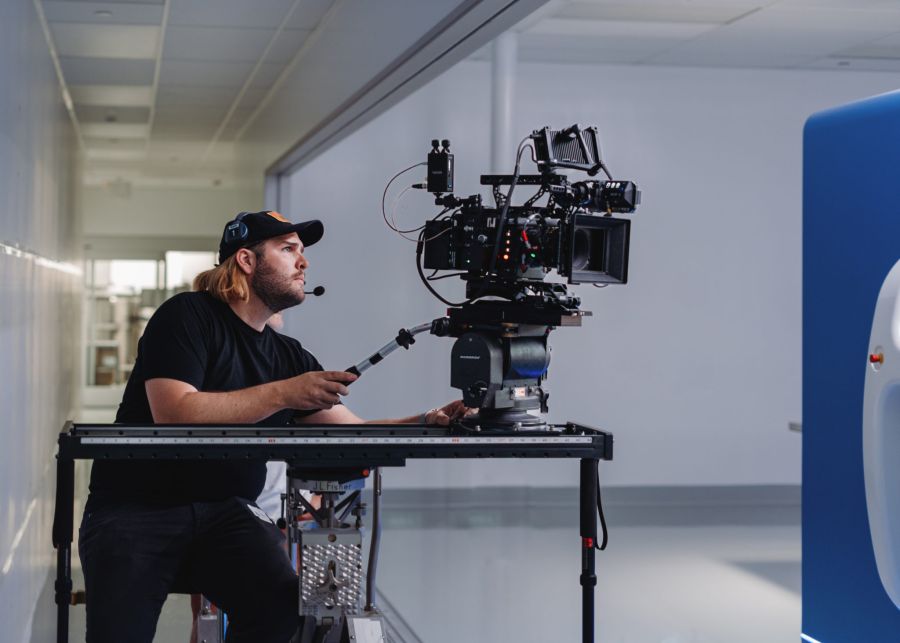
The commonest mistake is choosing animation to avoid a shoot. If the product exists and can be held, filming it and animating only the part that cannot be seen almost always produces a stronger film than animating the whole thing, and the motion graphics then carry the weight where they genuinely add something.
How an explainer is actually made
The order matters more here than on any other format, because each stage locks the one after it.
- Script. Written to a single idea, read aloud, cut. Nothing else starts until this is signed off, because every later stage is built on it.
- Voice record. Counter-intuitively this comes before animation, not after. The animation is timed to the real recorded voice; animating first and recording later means re-timing everything.
- Storyboard and style. What each beat looks like, agreed as stills. This is the cheapest place to change your mind and the last one where changes are free.
- Animation or shoot. The longest stage and the one with the least room for revision, which is why the three above exist.
- Sound and mix. Music, effects, and the pass that makes the voice sit properly. Skipped more often than it should be, and audible when it is.
The expensive mistake is rewriting the script after animation has begun. A word change in the voiceover is a re-record and a re-time of every scene it touches.
How long an explainer should be
Shorter than the brief wants, and the constraint should be set before writing rather than discovered in the edit.
Length is decided by where the film plays and how much the viewer has already committed. Someone who clicked a link on a product page has more patience than someone scrolling a feed, and a film shown by a salesperson in a live conversation can run longer than either because a person is watching them watch it.
What genuinely determines whether a film feels long is not its duration but whether every section is still doing work. A tight three minutes holds better than a padded ninety seconds. The useful discipline is to cut the film to its argument, then check the runtime, rather than writing to a target and trimming to fit.
When an explainer is not the answer
If the product is genuinely simple, an explainer draws attention to a complexity that was not there. Some things are better sold with a photograph and a sentence, and commissioning a film to explain them creates a doubt in the viewer that the product had not earned.
If the confusion is about who it is for rather than what it does, that is a positioning problem and a film will make it louder. And if two stakeholders disagree about what the product actually is, the explainer will not settle that argument. It will surface it in script review, usually around round three, at which point everyone is paying for the disagreement.
The honest sequence is: settle the sentence first, then commission the film that carries it.
What an explainer video costs
A single-location shoot generally starts around $5,000. Multi-day or multi-location work with a larger crew runs $15,000 to $100,000. The full breakdown is on what video production costs.
Explainer budgets behave differently from the rest, because the variable is not shoot days. It is how much has to be built rather than captured. A filmed explainer with a few graphic overlays sits at the lower end. A fully animated piece with an original visual style, custom illustration and a bespoke mechanism sequence is a build, and it is priced like one: the cost is in the frames, not the days.
The lever that matters most is deciding the animation scope before the script is locked. Adding one sequence that shows an invisible process can be the difference between two treatments of the same film at very different prices, and it is a decision worth making deliberately rather than discovering during storyboarding.
Explainer Video Production Services
Over the years, we have produced several explainer videos that have educated, informed and inspired people to learn more about a product, service, or non-profit. Whether it’s a simple instructional video or a more complicated quirky explainer, we’ve got you covered. You only get one chance to make an unforgettable first impression to entice your audience. Why not turn your idea into a reality with an explainer video production in San Francisco? Luma Creative offers a wide range of video production services to create new types of video that bring your vision to life.
Explainer video production is all about delivering complex, sometimes dry corporate content to your audience with immersive and appealing visual guidance and graphics. This helps your customers and clients to comprehend the message without losing interest. You might think of old infomercials, but explainer videos can be so much more. Looking to create an explainer video in San Francisco? Learn more below!
Different Types Of Explainer Videos
Explainer videos come in many different shapes and sizes. Our most popular is a live action video. Meaning that it is shot with real people in real environments. The second most popular method is an animated explainer video. These are entirely computer generated and the only human element about them is usually the voiceover talent. The production costs for these are typically pretty minimal. With either option, it’s imperative that we work together during preproduction to distill the information into bite sized pieces. Whether you need to break the video into a series, or pack it all into one video, should be a serious consideration. Think of it like in your school years. By the end of a two hour lecture, you had likely tuned out an hour ago. Compare that with a thirty minute lecture and you likely retained all the information and were ready to apply it.
In the sample below, we used real talent to explain how to run a successful business on Turo. The goal of this video was to be energetic and position Turo in a positive light in order to build positive brand awareness while also educating the viewers to be successful themselves!
Understanding Our Process
Our explainer video production services is a 6-step process which is as follows.
- Step #1 – Brainstorming concepts and ideas. How can we hook the viewer?
- Step # 2- Constructing a vision to tell a story. What’s the most direct way to explain the product/service?
- Step #3 – Pre-production planning. Where will shoot? How long do we need? Casting etc?
- Step #4 – Production and Shoot Days
- Step #5 – Post Production and Editing
- Step #6 – Delivery and/or Distribution
Frequently Asked Questions
An explainer video is a short live or animated video that explains something that your brand does. At Luma Creative, we can produce explainer videos in various formats for you to deliver your message in an engaging, creative, and memorable way.
Our explainer video specialist team has been developing explainer videos for brands in San Francisco since 2012. Speak to us today about your upcoming project.
An explainer video is a short video used for online marketing that you can use to explain your company’s process, products, and services. You can place these videos on your landing page, official website’s homepage, social media pages, and desired product pages.
An explainer video tells your target audience a story. Therefore, most of these videos will include some common components: the problem, the solution, how the solution works, and finally, a call to action (CTA). Some explainer videos also incorporate interview video production to add credibility and help customers connect with the people behind the product or service.
Typically it can take between two to four weeks for Luma Creative to ideate, produce, shoot and edit your explainer video. This timing duration involves the entire process, which requires several production experts including screenwriters, animators, illustrators, producers, voiceover actors, and more. Want to know more details? Read more about our Bay Area video production.
A single-location shoot generally starts around $5,000, and multi-day or multi-location work with a larger crew runs $15,000 to $100,000. Explainer budgets vary on how much has to be built rather than captured: a filmed piece with graphic overlays sits low, and a fully animated film with custom illustration is priced like a build, because the cost is in the frames.
It follows from whether the subject is visible. Animation is right for software logic, a process inside a machine, or a service with no physical form. Filming is right when a real object, place or person is the proof. If the product exists and can be held, filming it and animating only the invisible part usually produces a stronger film than animating all of it.
Shorter than the brief wants, and decided before writing rather than in the edit. Length follows from where it plays and how committed the viewer already is. What makes a film feel long is not duration but whether every section is still doing work.
Trying to explain more than one thing. A viewer who understands one thing clearly will go and find the rest themselves; a viewer shown five understands none. The second biggest is rewriting the script after animation has started, because a word change is a re-record and a re-time of every scene it touches.
Either, and the script is where an explainer is won or lost. The test is whether it works read aloud with no visuals at all. If a listener understands the thing from the words alone, the film will work. If the words only make sense with the diagram on screen, the animation is being asked to rescue the writing.
Script, then voice record, then storyboard, then animation or shoot, then sound and mix. The voice is recorded before animation rather than after, because the animation is timed to the real recorded read. Animating first means re-timing everything.
The main point of an explainer video is to help a viewer understand something. How we do that will be determined by how much content we are trying to get across, what level of fidelity we are going for, and the total budget for the project. Sure we could spend all the money on one video, but would it really accomplish all the messaging needed? Perhaps a little less production quality could yield more quantity. On the flip side, maybe you only have a little bit of knowledge that needs to be shared? If so, let’s make sure it’s polished and ready for primetime!
When you are ready to get started on your explainer video production, feel free to reach out!